How Long Should Meal Planning Take? (And How to Do It Faster)
How long should meal planning take? About 15-20 minutes a week. If yours takes an hour, here's where the time goes and how to get it back.
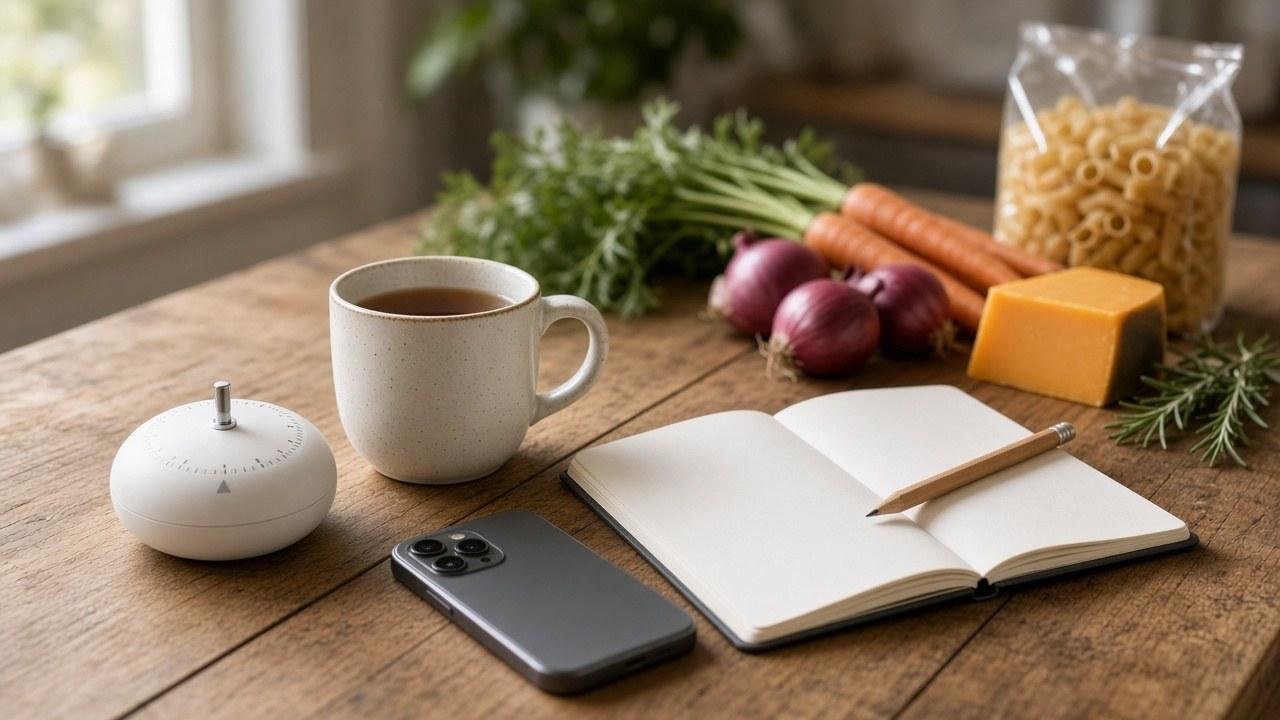
How long should meal planning take? For most households, a week of dinners plus the shopping list should take somewhere around fifteen to twenty minutes once you've got a system. If it's eating up an hour or more of your Sunday, the problem usually isn't you. It's that the method asks you to make far more decisions than the job needs.
I hear versions of this all the time, and I've felt it myself: sitting with a notebook and six open tabs, scrolling recipes, changing your mind, then writing out ingredients one by one. People describe being burnt out by the constant looking-up of meals, or say the hard part isn't cooking at all, it's choosing seven things at once before anyone is even hungry. That's the bit that takes the time, and it's the bit I built Foodedo to shrink.
Here's where the time actually goes, and how to get it back.
Where does meal planning time actually go?
If you timed a slow planning session, very little of it would be writing. Most of it is one of these:
- Browsing for ideas. Scrolling recipe sites or social media looking for something that sounds good. This is the biggest sink, and it rarely ends with a decision.
- Second-guessing. Picking a meal, then wondering whether it's too similar to last week, too much effort for a Tuesday, or something one person won't eat.
- Checking what everyone wants. Asking the household, getting 'I don't mind', and being left to decide anyway.
- Copying ingredients. Going through each recipe and writing out what you need, then merging duplicates by hand.
- Starting from a blank page. Every week begins from nothing, as if you'd never cooked a dinner before.
Almost all of that is decision-making rather than planning. I wrote about why that's so draining in why deciding what's for dinner is harder than cooking it. The short version is that choosing is the expensive part, so the quickest way to plan faster is to make fewer choices.
Is it normal for meal planning to take an hour?
It's common, especially when you're starting out, but it isn't necessary. An hour usually means you're treating every week as a fresh creative project. Some people enjoy that, and if it's your Sunday hobby, carry on. But if planning feels like a chore you put off until Saturday night, an hour is a sign the process needs trimming, not that you need more willpower.
The aim isn't the fastest possible plan. It's a plan that's good enough to cook from and quick enough that you'll actually do it again next week.
Stop starting from a blank page
The single biggest time saver is a list of dinners your household already eats. Not aspirational recipes, just the meals that get cooked and finished: the pasta bake, the curry, the fajitas, the Friday thing. Most families rely on a surprisingly small set.
With that list, planning stops being 'what could we eat?' and becomes 'which of these this week?', which is a far quicker question. If you're not sure how big that list should be, how many meals should be in a dinner rotation works through it.
Then add one new recipe a week at most, if you want one. New recipes are where the browsing and second-guessing live, so ration them.
Plan fewer dinners
You don't need seven planned dinners. Planning four or five, with a leftovers night and a fallback night, cuts the decisions by a third and makes the plan more likely to survive a real week. Fewer meals also means a shorter shopping list, which saves time twice.
Put a time limit on it
This sounds too simple, but it works. Set a timer for fifteen minutes and decide that whatever you've got when it goes off is the plan. Deadlines stop the browsing spiral, because 'good enough' becomes the goal rather than 'perfect'. If you hit the limit with three dinners chosen, fill the gaps with favourites from your list and move on.
Let someone (or something) make the first draft
Reacting is much faster than creating. It takes seconds to look at a suggested dinner and say 'yes' or 'not that one', and minutes to come up with it yourself. That's why theme nights help some people: pasta Wednesday turns an open question into a small one.
You can get the same effect by letting someone else in the house propose the week while you just approve or swap. Or by using a tool that drafts it for you, which is the approach I took with Foodedo (more on that below).
Build the shopping list from the plan, not alongside it
A lot of planning time disappears into the shopping list: flicking back through recipes, writing down '1 onion' four times, then working out you need four onions. If your list is built directly from the meals you've chosen, that step mostly vanishes.
The order matters: dinners first, then the list, then a quick check of the cupboards for things you already have. I go through the mechanics in how to build a shopping list from your meal plan.
Keep your recipes in one place
Hunting for 'that chicken recipe from a few weeks ago' across screenshots, bookmarks and browser history is a hidden time cost. If the recipes you actually cook live in one place, picking them for a plan is quick.
This is also where a lot of saved recipes quietly go to die. If your collection is big and you cook almost none of it, why do I save recipes I never cook is about turning that pile into actual dinners.
How Foodedo cuts the time down
I built Foodedo because the deciding was the part I kept avoiding. So it works the other way round from most planners: when you generate a plan, it picks the dinners for you first. The suggestions are based on simple behaviour, such as the meals you've saved, liked, used before or turned down, so the more you use it, the more the first draft looks like food you'd actually choose.
Choosing meals yourself is optional. If one dinner doesn't suit, you can swap just that one rather than starting again. Once you're happy, the shopping list comes from the plan and stays linked to it, so you're not copying ingredients by hand.
If you've got recipes you already like, you can save them by importing from a link or pasting the text in, so your own favourites can turn up in plans. To be honest about the limits: some recipe sites won't import cleanly, so you may need to paste the text instead. And Foodedo doesn't track your pantry, so a quick check of the cupboards before you shop is still on you.
In practice, that turns planning into reviewing a suggested week, swapping anything that doesn't fit, and glancing over the list. That's the kind of job that fits in a tea break rather than a Sunday morning.
A fifteen-minute weekly routine
Whatever tools you use, this is a routine that works for most households:
- Two minutes: look at the week ahead. Which nights are late, busy or out?
- Five minutes: pick four or five dinners, mostly from your list of favourites, with quick ones on busy nights.
- Three minutes: decide on a leftovers night and a fallback meal.
- Five minutes: build the shopping list from those dinners and check the cupboards.
That's it. If it still takes much longer than that, look at which step is dragging. Nine times out of ten it's the browsing, and the fix is a better list of favourites, not more inspiration.
The real goal
A good meal plan isn't the most varied or the most beautiful one. It's the one you can make quickly enough that you'll do it again next week, because the time you save on planning is only useful if the habit sticks.